
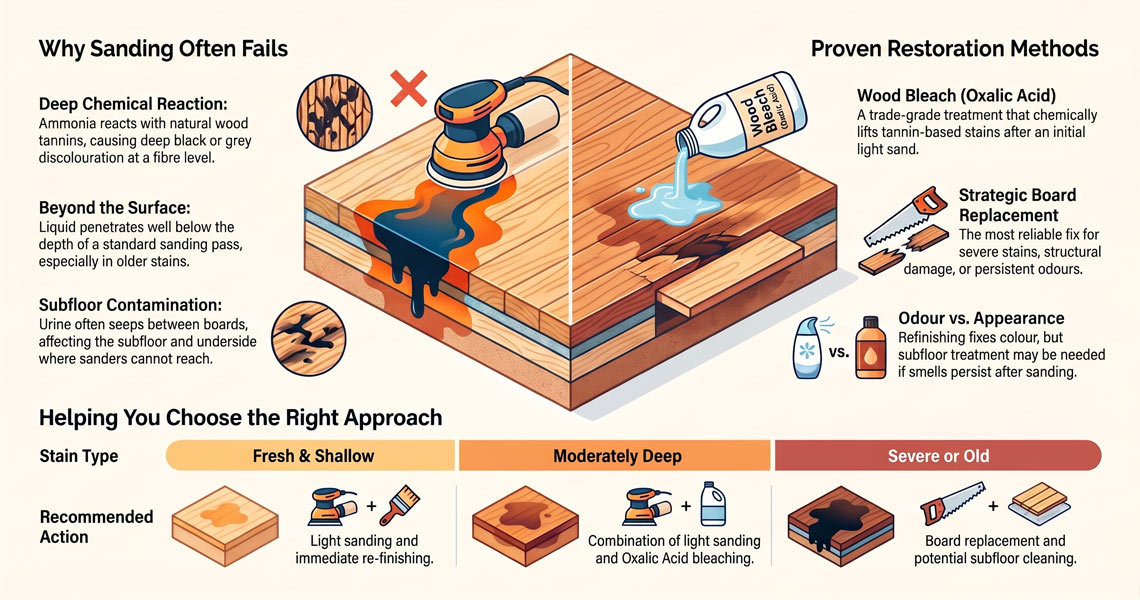
The honest answer is: often, no — at least not completely, and not with sanding alone. It's a disappointing answer if you're staring at a dark patch on your floor hoping a resand will make it vanish, but going in with realistic expectations will save you time and a repeat repair. Here's why urine stains behave differently to other marks on wood, and what genuinely works instead.
Why Pet Urine Stains Are Different
Most marks on a wood floor — scuffs, surface scratches, light discolouration from a spilt drink — sit in the top layer of the finish or the very outer fibres of the wood. A standard sand removes that top layer and takes the mark with it.
Urine stains are a different problem for a few reasons:
They penetrate deep into the wood. Urine is a liquid that soaks into timber, and depending on how long it sat before being cleaned, it can travel well below the depth a standard sanding pass removes. A light sand might only take off the surface of the stain, leaving the deeper discolouration untouched.
They chemically react with the wood. Urine's ammonia content reacts with the natural tannins in wood, causing a genuine chemical stain rather than a surface deposit. This is why urine marks often look almost black or deep grey, and why they can't simply be cleaned or lightly abraded away — the wood itself has changed colour at a fibre level.
They can affect more than one board. If urine has soaked through gaps between boards, it can reach the subfloor or the underside of adjacent boards, meaning the visible stain on the surface isn't necessarily the full extent of the problem.
Repeated exposure compounds the issue. A one-off accident, cleaned up quickly, is far less likely to leave a deep stain than repeated accidents in the same spot over weeks or months, which is a common scenario with puppies, elderly pets, or a favourite corner a cat keeps returning to.
So Can Sanding Help at All?
Sanding isn't useless here — it depends on the specifics:
- Fresh, shallow stains that were cleaned up quickly and haven't had time to penetrate deeply can sometimes be sanded out fully, particularly on solid hardwood floors with enough wear layer to work with.
- Engineered floors have far less room to work with. Their wear layer is thinner than solid wood, so even a stain that would be manageable on a solid floor may not be removable without sanding through to the substrate underneath.
- Old or repeated staining usually goes deeper than a standard sand can safely remove, especially without thinning the boards to a point where the floor's future refinishing life is significantly reduced.
- A stain that's travelled between boards or into the subfloor won't be resolved by sanding the surface at all, since the source of the discolouration isn't on the surface being sanded.
In short: sanding might lighten a urine stain, and occasionally remove a genuinely fresh, shallow one — but it's not a reliable fix for anything beyond that, and treating it as one risks sanding the boards thinner than necessary for a result that still doesn't fully work.
What Actually Works
Wood bleach (oxalic acid). This is the standard trade approach for urine and water stains, and often the most effective. Oxalic acid reacts with the same tannin-based discolouration that caused the stain, lifting it chemically rather than trying to sand it away physically. It's typically applied after an initial sand, left to react, then neutralised and lightly sanded again before refinishing.
Combining light sanding with bleaching. For stains that are only moderately deep, a light sand to open the wood grain followed by an oxalic acid treatment often achieves a better result than either method alone.
Board replacement. Where a stain is severe, has affected the subfloor, or comes with lasting odour, replacing the affected board or boards is frequently the more reliable long-term fix, particularly for engineered floors where sanding depth is limited.
Addressing odour separately from colour. It's worth knowing that colour and smell are two separate problems. A board can be successfully bleached and refinished and still retain odour if urine has soaked into the subfloor beneath it, since the finish sits on top of the wood rather than sealing what's underneath. If odour persists after refinishing, the subfloor itself may need attention, not just the visible board.
A full re-finish once the stain is treated. Whichever method resolves the colour issue, the affected area will need a fresh finish to match the rest of the floor and protect the wood going forward, since bleaching and localised sanding will leave a section of untreated, unsealed wood.
When to Call a Professional Rather Than DIY It
Household stain removers and DIY bleach products aren't the same as trade-grade oxalic acid treatments, and using the wrong product can lighten the surrounding wood unevenly or fail to reach the depth of the actual stain. A professional assessment can also tell you:
- Whether the stain is shallow enough to realistically sand or bleach out
- Whether the subfloor has been affected and needs separate treatment
- Whether board replacement will genuinely give a better result than trying to save the existing boards
- How the repaired area can be blended with the rest of the floor's finish, colour, and sheen
Preventing It Going Forward
- Clean any accident as soon as possible — the faster urine is lifted, the less time it has to penetrate and react with the wood
- Use a proper enzymatic pet-stain cleaner rather than standard household cleaning products, which don't break down the compounds causing the odour and staining
- Keep an eye on any spot a pet keeps returning to, since repeated small accidents in the same place cause far worse staining than a single event
- Consider a rug or mat in high-risk areas — near a cat litter tray, a puppy's usual corner, or an older dog's favourite spot — while training or medical issues are being managed
Getting an Honest Assessment
If you're dealing with a stain and want a straight answer on whether it can realistically be sanded out, bleached, or needs a board replaced, that's genuinely easier to judge in person than from a description or photo. Our hardwood floor sanding and engineered wood floor sanding services include stain assessment as part of the job, and where a board is beyond saving, our floorboards replacement service covers replacing it and blending it in with the rest of the floor.
You can book a free visit and we'll give you a realistic answer on what's achievable before any work goes ahead.