
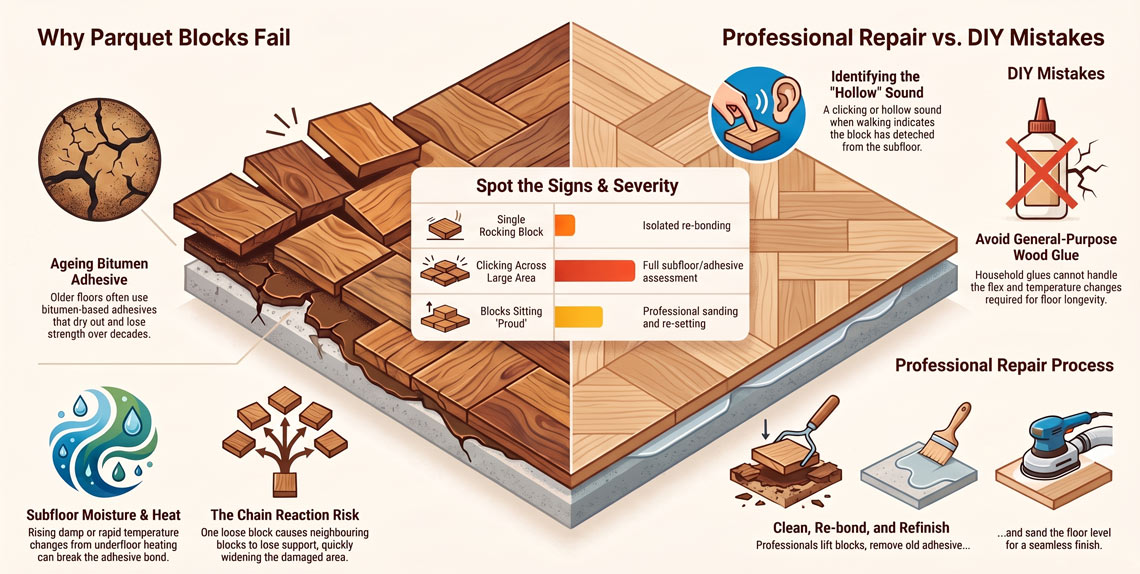
A parquet floor that's starting to rock, click, or lift underfoot is more than just an annoying noise. Loose blocks are usually a sign that the adhesive bond holding them to the subfloor has failed in that area, and left unaddressed, a handful of loose blocks can turn into a much larger and more expensive repair. Here's what tends to cause it, how to tell how serious it is, and what an actual fix involves.
Why Parquet Blocks Come Loose
Parquet blocks are typically bonded directly to a solid subfloor with adhesive rather than nailed or fixed mechanically, which means the entire strength of the floor depends on that adhesive bond staying intact. When it fails, blocks lose their grip and start to move.
Ageing adhesive. Many older parquet floors, particularly those laid several decades ago, were fixed using bitumen-based adhesives. Over time, these can dry out, harden, and lose their adhesive strength, especially in floors that have seen years of foot traffic, furniture movement, and temperature changes.
Moisture reaching the subfloor. Damp rising through a solid floor, a leak, or persistent humidity can break down the bond between block and subfloor. Wood adhesives are generally not designed to cope with sustained moisture exposure, and once water gets underneath even a small section, adjacent blocks are often affected too.
Underfloor heating issues. Parquet laid over underfloor heating needs an adhesive rated for that application and a heating system that's brought up to temperature gradually. Rapid heat changes or an unsuitable adhesive can cause the bond to weaken, particularly around heat-source areas.
Subfloor movement. Cracks, unevenness, or slight movement in the subfloor itself can eventually break the adhesive's grip, even where the adhesive itself hasn't degraded.
Poor original installation. Insufficient adhesive coverage, the wrong adhesive for the subfloor type, or inadequate subfloor preparation at the time of laying can all lead to blocks coming loose years down the line, sometimes well before the rest of the floor shows any wear.
Signs to Look Out For
Loose parquet blocks don't always announce themselves straight away. Common early signs include:
- A hollow or clicking sound when you walk over a specific area, different from the rest of the floor
- Visible rocking or slight movement when you press down on individual blocks
- Small gaps opening up around the edges of one or more blocks
- Blocks sitting slightly proud of their neighbours, catching on socks or furniture legs
- A block that has fully detached and can be lifted out by hand
It's worth checking whether the issue is isolated to a single block, a small cluster, or spread across a wider area, since that has a real bearing on what kind of repair is appropriate.
Is It Safe to Leave?
A single loose block in a low-traffic area isn't an emergency, but it's not something that fixes itself, and delaying only makes the repair more involved. A block that's free to move will wear unevenly against its neighbours, the edges can chip or splinter, and moving foot traffic can gradually widen the affected area as neighbouring blocks lose support too.
If the cause is moisture-related, waiting is particularly risky, because the same moisture that loosened the first block is often still present and will likely affect more of the floor the longer it's left unaddressed.
What Not to Do
Don't use general-purpose wood glue or a DIY contact adhesive to re-stick a loose block yourself. Parquet adhesives are formulated to cope with the specific stresses a floor puts on the bond — flex, moisture, temperature change — and a household adhesive is very unlikely to hold under normal foot traffic for long.
Don't ignore a moisture source and simply re-glue over it. If damp caused the block to come loose in the first place, re-adhering it without dealing with the underlying moisture issue means the repair is likely to fail again.
Don't sand a floor with loose blocks present. Sanding puts lateral pressure on the surface, and a loose block can shift, chip, or be pulled further out of position during the process, potentially damaging the sanding equipment as well as the floor.
How Loose Parquet Blocks Are Properly Repaired
Isolated loose blocks are generally lifted out carefully, the old adhesive is cleaned from both the block and the subfloor, and the block is re-bonded using an adhesive suited to the subfloor type and any heating system present. Where a block has cracked, chipped, or gone missing entirely, a matching replacement block is sourced and fitted in its place.
Wider areas of loose or lifting parquet usually point to a bigger issue with either the original adhesive or subfloor moisture, and the repair approach depends on what's found. In some cases this means lifting and re-laying a whole section; in others it means addressing a moisture source first and then re-bonding affected blocks once the subfloor is confirmed dry.
After repair, refinishing is often needed to blend replaced or re-set blocks in with the surrounding floor, since new or re-adhered blocks can sit at a slightly different level or finish sheen until they've been sanded level and resealed with the rest of the room.
Getting It Assessed
Because the right fix depends heavily on the cause — old adhesive, moisture, subfloor movement, or an installation issue — a proper repair really starts with identifying why the blocks came loose, not just re-sticking what's visible. A quick visual check often isn't enough to catch an underlying moisture problem, so an in-person assessment is the most reliable way to know what you're actually dealing with.
Our parquet floor sanding service covers assessment, re-bonding of loose or damaged blocks, and refinishing once repairs are complete, so the repaired area blends into the rest of the floor rather than standing out. For a full look at your options, you can also see our wider floor repairs services.
If you've noticed loose or lifting blocks and want an honest opinion on what's causing it, you can book a free visit and we'll take a look before recommending anything.