
If you've been searching for what it actually costs to restore original Victorian floorboards, you've probably noticed most sites won't give you a straight answer. That's partly because no two Victorian floors are the same — condition, board width, subfloor state, and how much replacement is needed can vary enormously from one house to the next, so a single figure would be misleading either way. What we can give you is a realistic breakdown of what drives cost up or down, and roughly where different scopes of work tend to sit relative to each other.
Why Victorian Floorboards Vary So Much in Cost
Victorian properties are typically over a century old, and how a floor has been treated since it was laid matters just as much as its age:
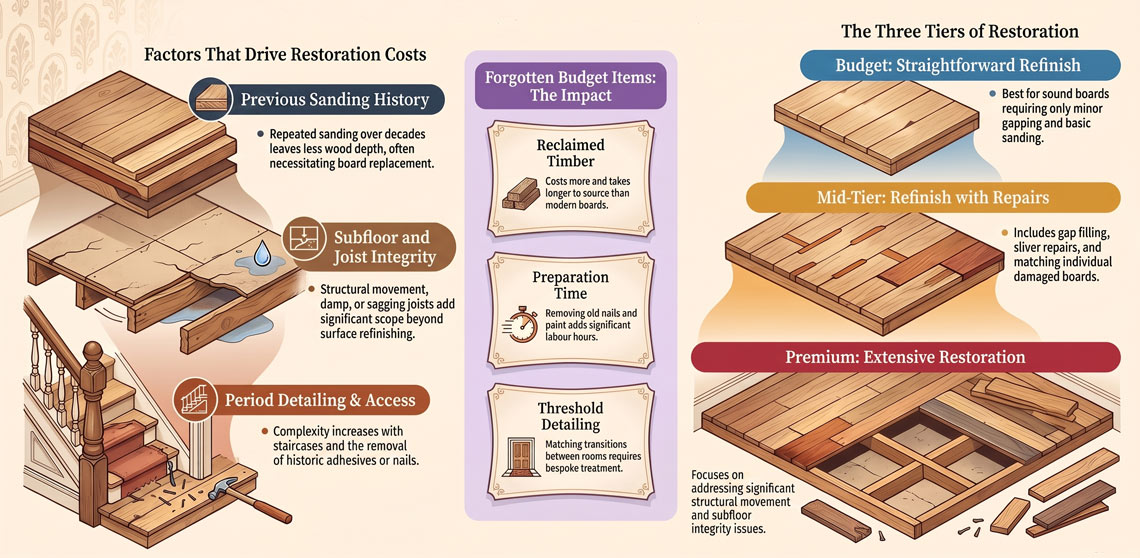
- Previous sanding history. A floor that's been sanded several times over the decades has less depth left to work with, which limits what can be done and can push more of the job toward board replacement rather than straightforward refinishing.
- Board condition. Splits, woodworm damage, historic staining, and boards that have been cut into for old pipework or cabling all affect how much of the floor is salvageable versus needing replacement.
- Gaps and movement. Older floors often have wider, less uniform gaps than modern floors, which can mean sliver or fillet repairs rather than simple filler in places.
- Subfloor and joist condition. If joists have moved, sagged, or been affected by damp over the years, that's a separate consideration from the boards themselves and can add to the scope of work.
- Access and layout. Fitted furniture, pipework runs, staircases, and awkward room shapes all affect how straightforward the sanding and finishing process is.
- Finish choice. Hard-wax oil, lacquer, and staining all involve different levels of work and drying time, which factors into overall cost.
Realistic Cost Tiers by Scope of Work
Rather than a single number, it's more useful to think about restoration in terms of scope, since that's what actually drives where a job lands on the cost spectrum.
Budget-tier: straightforward refinish. This covers original boards that are in reasonably sound condition, with only minor gapping and no significant board replacement needed — essentially a sand and refinish of boards that have held up well. This is the least involved scope and sits at the lower end of the cost range as a result.
Mid-tier: refinish with repairs. This is the most common scenario for genuine Victorian boards — a sand and refinish combined with some gap filling, sliver or fillet repairs, and possibly a small number of board replacements where individual boards are too damaged to save. Because it involves more assessment, repair work, and matching of old timber, this sits noticeably above a straightforward refinish.
Premium-tier: extensive restoration. Where a significant portion of the floor needs board replacement, where subfloor or joist issues need addressing alongside the floor itself, or where reclaimed or matched period timber needs to be sourced to replace missing sections, the scope of work — and therefore the cost — increases considerably. This tier is common in properties where boards were removed and never properly reinstated, or where damp or woodworm has affected a meaningful portion of the floor.
Where any individual floor lands within these tiers depends on the specific condition assessment, which is genuinely difficult to estimate accurately without seeing the floor.
Costs People Often Forget to Budget For
A few things catch people out when they're pricing up a restoration based on the visible boards alone:
- Matching reclaimed or period-appropriate timber for replacement boards, which typically costs more and takes longer to source than modern standard-width boards
- Subfloor or joist repairs, if uncovered once boards are lifted, which is a separate job from the floor finish itself
- Staircase and threshold detailing, since Victorian properties often have nosings, thresholds, or transitions between rooms that need matching treatment
- Extra preparation time for removing old nails, historic paint, or adhesive residue that modern floors typically don't have
DIY vs Professional Restoration
Sanding a Victorian floor yourself is possible for straightforward, well-preserved boards, but the margin for error is higher than with a modern floor. Old boards can have irregular surfaces, hidden nails, and inconsistent thickness from repeated sanding over the decades, all of which increase the risk of gouging or sanding through the board entirely on a DIY attempt. For a floor with genuine period value, most homeowners find the assessment and repair work — deciding what can be saved versus replaced — is where professional experience actually pays for itself, more so than the sanding itself.
Getting an Accurate Picture for Your Floor
Because condition varies so much from house to house, the only reliable way to know which tier your floor falls into is a proper in-person assessment. Our floorboards replacement and gap filling services cover the repair side of period floor restoration, and our hardwood floor sanding service handles the sand and refinish once repairs are complete.
You can book a free visit and we'll assess your floor's condition and give you a clear, honest picture of the scope of work involved before anything is agreed.