
If you've run your hand across your floor and felt the edges of each board sitting slightly higher than the centre, you're dealing with cupping. It's one of the most common wood floor problems homeowners notice at the end of winter, and it can look alarming — but in most cases it's a moisture issue rather than a structural one, and it's often reversible. Here's what's actually happening, why winter tends to bring it on, and what you should (and shouldn't) do about it.
What Cupping Actually Is
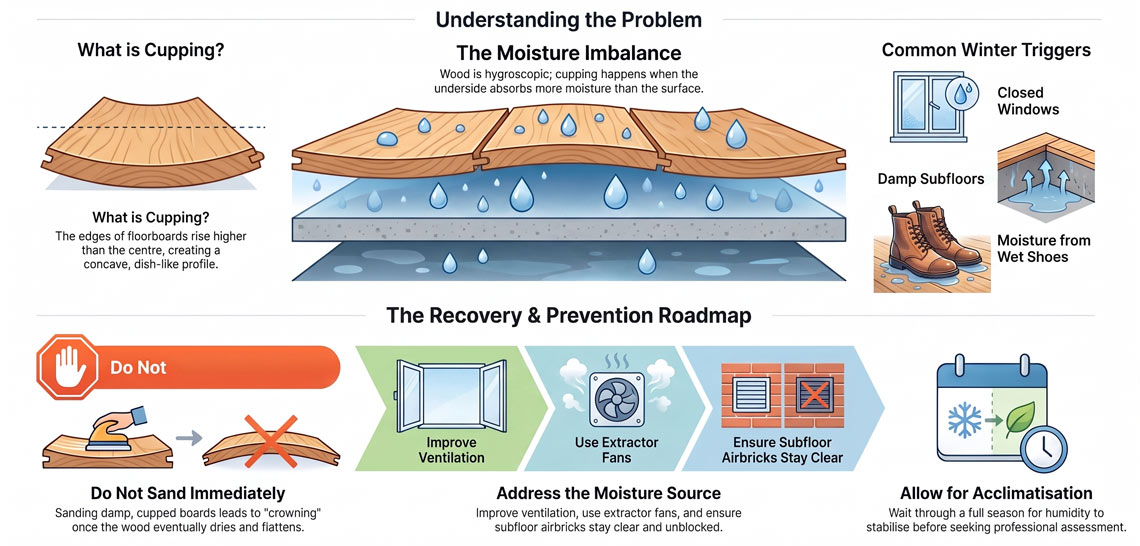
Cupping happens when the edges of a floorboard rise higher than its centre, giving each board a slightly concave, dish-like profile. Run your hand across the floor and you'll feel a ridge along each board edge rather than a flat, continuous surface.
Wood is hygroscopic, meaning it constantly absorbs and releases moisture from the air and the subfloor around it. When one face of a board takes on more moisture than the other, it expands unevenly. If the underside of the board absorbs more moisture than the top — which is the usual pattern — the bottom expands more, and the board bows upward at the edges. That's cupping.
It's different from crowning, where the centre of the board sits higher than the edges (often the result of over-sanding a floor that had already cupped, or moisture coming from above rather than below), and different from gapping, where boards shrink and pull apart, leaving visible lines between them.
Why Cupping Tends to Show Up Around Winter
Cupping is generally associated with a rise in moisture, so it can seem strange that it often becomes noticeable during or just after the colder months. A few winter-specific factors tend to be behind it:
Reduced ventilation indoors. Windows stay shut for longer, extractor fans get used less, and moisture from cooking, showers, and drying laundry indoors has fewer places to escape. That pushes indoor humidity up, and the floor's surface absorbs some of it.
A cold, damp subfloor. If your home sits on a concrete slab or has a crawl space beneath suspended timber floors, the subfloor is often colder and more moisture-laden in winter than the room above it. Wood picks up moisture from whichever side is more humid, and in winter that's frequently the underside — which is exactly the pattern that produces cupping.
Condensation. Cold external walls, single-glazed windows, or poorly insulated areas can produce condensation that runs down onto the floor near skirting boards and window reveals, adding localised moisture exactly where it's easy to miss.
Wet shoes, boots, and melting snow. Water tracked in from wet weather, left to sit rather than being wiped up promptly, is a very ordinary but often overlooked cause of edge swelling near entrances.
Humidifiers or drying racks near the floor. Anything that raises the moisture content of the air directly above a section of flooring for extended periods can cause localised cupping in that specific area.
The common thread is a moisture imbalance between the top and bottom of the boards, and winter conditions in the UK — closed-up houses, condensation, wet weather — make that imbalance more likely.
Is It Temporary or Permanent?
This is the question that matters most, and the honest answer is: it depends on how long the moisture imbalance has been present.
Seasonal cupping is common and usually mild. If your floor cups slightly in winter and largely flattens out again once the heating season ends, indoor humidity normalises, and airflow improves, this is often just the wood responding naturally to seasonal humidity swings. Solid hardwood, in particular, moves more with the seasons than engineered wood, so a small amount of seasonal movement isn't necessarily a fault.
Persistent or severe cupping is a different matter. If the boards stay cupped well into spring and summer, if the cupping is pronounced enough that you can see daylight-level shadow lines along the edges, or if it's concentrated in one specific area rather than spread across the room, there's likely an ongoing moisture source that needs identifying — a subfloor damp issue, a leak, poor ventilation under a suspended floor, or condensation that's become a recurring problem rather than a one-off.
What to Do If You Notice Cupping
- Don't sand it immediately. This is the most important point. Sanding a cupped floor while it's still absorbing moisture is one of the most common mistakes homeowners and even some contractors make. If the boards later dry out and flatten, you can be left with the opposite problem — crowning — because the edges, which were sanded level with the raised centre, are now lower than the flattened centre.
- Identify and address the moisture source. Improve ventilation, run an extractor fan when cooking or showering, avoid drying laundry on radiators in the room, and check that any condensation on windows or walls isn't reaching the floor.
- Check the subfloor if the problem is persistent. For suspended timber floors, airbricks and underfloor vents need to stay clear and unblocked. For solid floors, a damp-proof issue in the slab is worth investigating if cupping keeps recurring in the same spot.
- Give it time. Mild seasonal cupping in solid wood floors often resolves on its own once humidity levels settle. Wait through a full season before deciding the floor needs professional attention.
- Get it assessed if it doesn't improve. If cupping is still present once your home's humidity has stabilised, or if it's severe enough to affect the finish or create trip-prone ridges, it's worth having someone measure the moisture content of the boards and subfloor to establish whether the wood has genuinely settled into a new shape or whether there's still an active moisture problem.
When Sanding Becomes the Right Fix
Once a floor has been given time to acclimatise and the moisture source has been dealt with, sanding is generally the correct way to restore a flat, level surface if the boards haven't returned to their original profile on their own. This is a job for someone experienced with reading a floor's moisture levels before machining it, since sanding too early is how crowning problems start. If you're at that stage, our hardwood floor sanding and engineered wood floor sanding services cover assessment and refinishing once a floor has stabilised.
If cupping has left noticeable gaps between boards once it settles, that's a separate but related issue our gap filling service addresses using standard gap filling between floorboards. And if the finish itself has dulled or lifted as a result of the moisture exposure without the boards themselves needing a full sand, a floor recoat may be all that's needed rather than a complete resand.
Preventing It Next Winter
- Keep indoor humidity reasonably stable through the colder months — running an extractor fan and cracking a window during and after cooking or showering makes a real difference
- Wipe up wet footwear moisture near entrances rather than letting it sit and soak in
- Make sure airbricks and subfloor vents stay clear over winter
- Address condensation on windows and cold walls promptly rather than letting it run down to skirting level
- If your home has a history of subfloor damp, get it checked before the wood floor takes the strain of it every year
Cupping after winter is common, and in most UK homes it's a sign of a normal seasonal moisture swing rather than a failing floor. The key is not rushing to sand it while it's still moving, and instead giving the wood a chance to settle before deciding what, if anything, it actually needs.
If you're unsure whether what you're seeing is seasonal movement or something that needs fixing, you can book a free visit and we'll take a look and measure the floor's moisture levels before recommending anything.